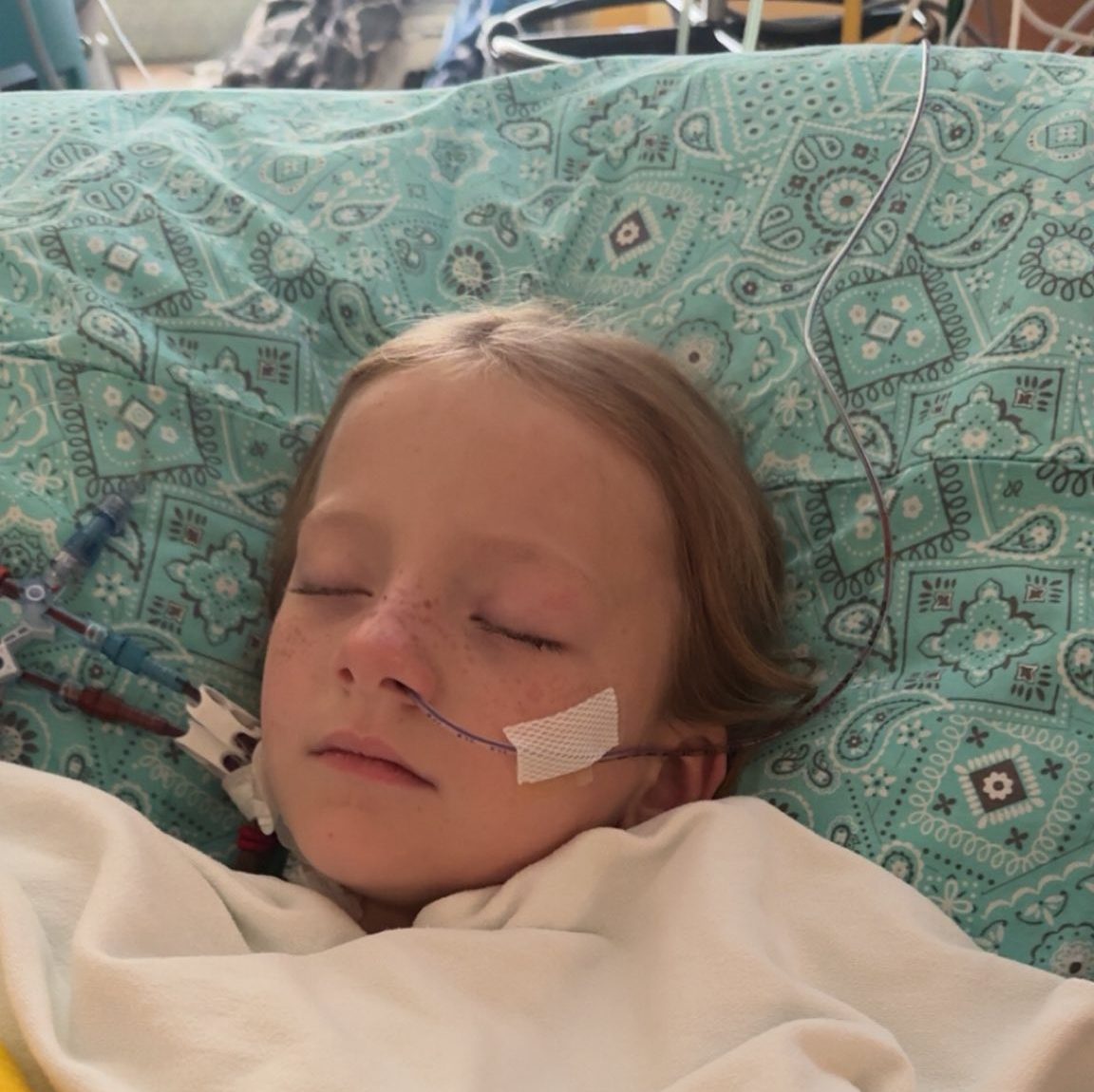
Eden’s Story
August 2025
7 Years
Location: Wisconsin
Source: Unknown, but maybe from an inflatable water slide
Infection: Shiga toxin-producing E.coli (STEC)
Disease: Enteroaggregative E.coli (EAEC)
Days Hospitalized: 20
Days of Dialysis: 6

The week before symptoms started, 7 year old Eden spent a lot of time at VBS at church. August 8, 2025, the last day of VBS, they had blown up water inflatables and celebrated with Culver’s ice cream.
On Thursday, August 14th, Eden was complaining of a severe stomachache right before going to bed. I (Mom) told her to go to sleep, and she would most likely feel better in the morning. Halfway through the night, Eden crawled into bed with me and was crying in pain.
The next morning, she told me she was pooping red. This concerned me as I know she consumed anything red in the last 24-48 hours. I asked her to show me the next time she went to the bathroom. She did, and I noticed it was bloody diarrhea. At this point, I brought her into St. Elizabeth’s ER. They told me it was most likely a gastrointestinal bug, as her lab work was coming back normal. She ended up having another bowel movement while there, and they decided to test the stool. They told me they would let us know if it was anything more, but to keep up on fluids and pain medication at home. They said they could start antibiotics, but ultimately wanted her to try to recover on her own.
The morning of August 16th, she was not feeling any better and was still in severe pain despite taking pain medications and keeping up on fluids. I decided to make an appointment with another pediatrician in her pediatrician’s office. The doctor told us that the stool sample came back positive for Shiga toxin-producing E.coli (STEC) for Shiga toxins 1 and 2. He suggested she get a shot of antibiotics and start on oral antibiotics. We later discovered that antibiotics should never be given with an STEC infection. It increases the chances of developing HUS.
The next day, August 17th, she was even worse. I called the nurse to inform her that Eden stopped taking fluids and had started vomiting. The nurse told me to take her back to the ER and suggested asking them to give her medication to stop the diarrhea. I brought her to the ER at St. Elizabeth’s again, where they only gave her Zofran and fluids. They said her blood work still didn’t look bad, so sent us home.
On Monday, August 18th, she stopped urinating all together. I called her primary pediatrician and said something was seriously wrong with Eden. I wanted to bring her back to the ER, but only if I knew they would admit her. He told me to take her to Thedacare, where they had the children’s hospital connected to it. When we got there, they did a blood draw and within an hour came in and said her lab results were very concerning.
Eden was transferred to Children’s Wisconsin, located in Milwaukee. She was admitted to the pediatric intensive care unit (PICU). The team of doctors explained to us that Eden was very, very sick and her kidneys had shut down. She was in complete renal failure. Along with this, she was anemic, had low platelets, and had thrombosis. They kept her stable overnight, and the next morning, we saw the nephrology team. This is where they confirmed she had STEC that had developed into Hemolytic Uremic Syndrome (HUS), a rare childhood red blood cell disorder.
The decision was made to start her on CRRT dialysis. The surgical procedure was about 1.5 hours. She was put to sleep and placed on a ventilator. During this time, they decided to also insert an arterial line to constantly monitor her blood pressure as it was very high. They informed us that due to the kidney issues, they could not use the medication to wake her up and kept her intubated overnight while she slowly woke on her own. The next morning, she was taken off the ventilator; however, she remembered everything from the previous night as she began waking up. It was devastating for us as parents to watch and traumatizing for her to experience. Due to not having much appetite and trying to get medications in her, we decided to insert an NG tube. She also received two blood transfusions due to a low hemoglobin count.
She spent 5-6 days in the ICU on CRRT dialysis. Once she was able to be switched over to HD dialysis, she was moved to the acute care floor. She continued to get another 2 rounds of HD dialysis. At this point, we were waiting for her kidneys to wake back up and start producing urine again, as well as for her blood counts to start leveling back out. We were told that most who are in acute care are only there for a couple of days. We ended up being there for 2 weeks. On Sunday, September 7th, we were informed we would be going home!
Being back home was an adjustment. Eden wanted to go back to school right away, so on September 8th, she started half days. Due to being wiped out at the end of each day, she continued with half days. In October, she started attempting some full days. She was doing great with the full days, but would have days when she still needed a “recharge day.”
Towards the end of October, she started complaining about belly pain again, and her blood pressure was still off despite being on high blood pressure medication. We followed up with nephrology, where they decided to lower her blood pressure medication and have us change what time she was taking it, as well as ruled out any remaining complications in her stomach from HUS. This is when we were informed her kidney function is at 85%, and this is likely where it will stay.
Today, she is still on blood pressure medication, but physically thriving. Her greatest challenge is dealing with PTSD from her traumatic hospital experience. Eden is in therapy to help process her trauma. We learned she is struggling to go to bed at night because she is afraid of waking up feeling so sick again. This is completely understandable, and we are trying to navigate how to make her feel safer when it is bedtime, and she is attempting to fall asleep.
As far as we know, her kidneys are still functioning at the 85% level. We are told this is almost normal (90-100), and we shouldn’t be concerned, as she can still have great function at this level. She is down to 4-6 week follow-up appointments, and at the 6-month timeframe, she will switch to once a year as long as her kidneys and blood pressure are stable.